
Trace Contaminants & Residues – Pesticides
Updated: May 18, 2026
While the idea of pesticides may evoke strong emotional responses, in this post, we’ll explore their purpose, how they end up in our food and water, and whether they pose a risk to human health.
Top Takeaways:
- Pesticides are substances used to control harmful organisms such as insects, weeds, fungi, bacteria, and rodents.
- Both conventional and organic farming use pesticides.
- Natural does not automatically mean safer than synthetic.
- Pesticide safety depends on dose, exposure, and toxicological profile.
- Regulatory agencies establish conservative residue limits designed to protect public health.
- Modern technology can detect pesticide residues at extremely small levels, often far below levels known to cause harm.
What is a pesticide?
A pesticide is a broad term used to describe substances intended to prevent, destroy, repel, or control harmful organisms.
These organisms may include:
- Insects
- Weeds
- Fungi
- Rodents
- Bacteria
- Mold
- Other agricultural or environmental pests
Pesticides can be naturally derived or synthetically produced. Importantly, both types are chemicals; they just have different origins.
Pesticides serve an important role in protecting crops, reducing food waste, controlling disease vectors, and supporting modern food systems.
Where are pesticides used?
Many people associate pesticides exclusively with farming, but we use pesticides regularly in everyday life.
Examples include:
- Household disinfectants like bleach
- Wasp and hornet sprays
- Mosquito control products
- Mold prevention products
- Agricultural crop protection products
In agriculture, pesticides help protect crops from insects, weeds, fungi, and plant diseases that could otherwise reduce crop yields, damage food quality, or threaten food security.
Without crop protection tools, farmers would face substantially greater food loss both in the field and after harvest.
Do organic and conventional farms both use pesticides?
Yes, when necessary, both organic and conventional farming practices use pesticides, though the types of pesticides and farming approaches may differ.
Organic farming often relies on:
- Naturally derived pesticides
- Biological pest management
- Crop rotation
- Specific soil management practices
- Pheromones and targeted pest disruption systems
Conventional farming may use:
- Synthetically or naturally derived pesticides
- Precision agriculture technologies
- Integrated pest management systems
Importantly, both organic and conventional pesticides are subject to safety evaluations and regulations.
The idea that “organic” automatically means “pesticide-free” is inaccurate.
Are naturally-derived pesticides safer?
Not necessarily. A substance’s origin does not determine whether it is safe.
One of the most important principles in toxicology is that both natural and synthetic substances can cause harm under certain conditions. Likewise, both natural and synthetic substances can often be used safely at appropriate exposure levels.
For example, we know arsenic is naturally occurring but can be highly toxic. Botulinum toxin is produced naturally by bacteria, yet highly purified forms are safely used in medicine.
In agriculture, we’ve seen that rotenone, a naturally derived pesticide once used in organic farming, was later linked to Parkinson’s disease-like effects and was discontinued in many agricultural uses. Likewise, DDT, a synthetic pesticide, was later restricted due to environmental and toxicological concerns.
As toxicology research evolves, regulatory decisions evolve alongside the science.
This is why toxicologists focus on evidence, exposure, and biological effects rather than whether something is labeled “natural” or “synthetic.”
As discussed in our overview of trace contaminants and residues, a substance’s origin does not automatically determine its safety profile.
What are pesticide residues?
Pesticide residues are extremely small amounts of pesticide material that may remain on or in food after agricultural use.
Modern analytical chemistry can detect these residues at extraordinarily tiny levels. In many cases, laboratories can identify substances at parts per billion or even parts per trillion concentrations.
The important question is not simply whether a residue exists, but whether the amount present is high enough to pose a meaningful health risk.
Presence does not automatically equal danger.
How are pesticide residues regulated?
In the United States, multiple federal agencies regulate pesticides and pesticide residues, including:
- Environmental Protection Agency (EPA)
- Food and Drug Administration (FDA)
- United States Department of Agriculture (USDA)
Before a pesticide can be approved for use, the EPA requires manufacturers to submit extensive scientific data for review. This evaluation process may include:
- Toxicology testing
- Exposure assessments
- Environmental impact analysis
- Dietary risk modeling
- Occupational safety assessments
- Long-term safety evaluations
The manufacturer is responsible for generating this data according to EPA test guidelines. The EPA then reviews the submissions and grants a registration (i.e., essentially a license to sell and distribute the product) only if it determines the pesticide will not cause unreasonable harm to human health or the environment when used as directed.
The EPA also helps establish residue tolerances, the maximum allowable levels of residues permitted on food products.
These tolerances include large safety margins designed to protect the public, including vulnerable populations such as children and pregnant individuals.
Importantly, actual residue levels found on foods are often significantly lower than these already conservative thresholds.
How much residue is allowed?
Researchers determine the safe level by evaluating the product’s toxicological profile and setting a limit that’s measured in parts per million (ppm).
A part per million is a small measurement representing one part in a whole entity of one million parts. For example, 7 drops of water in a 60-gallon bathtub is 1 part per million (ppm).
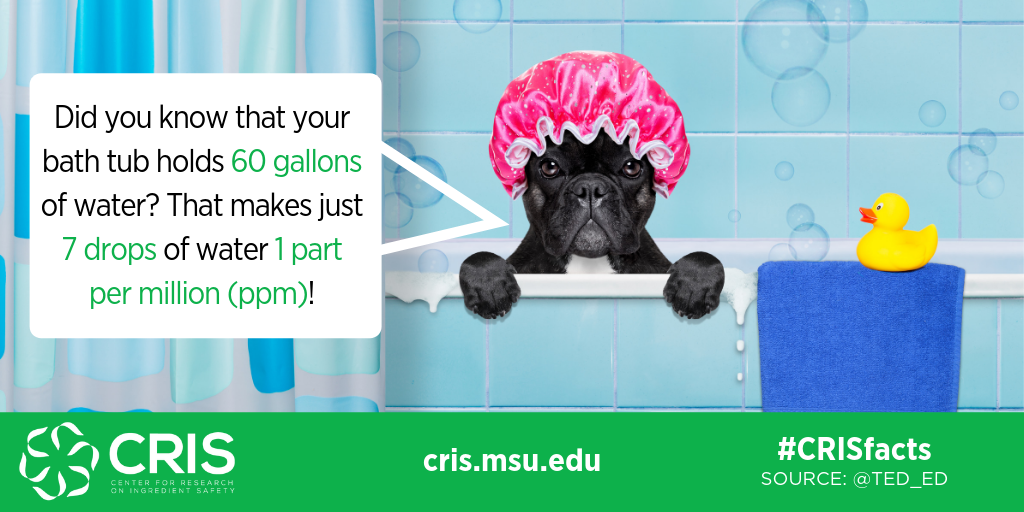
Ted Ed put together a fantastic video helping to explain parts per million.
When we talk about parts per billion (ppb) or parts per trillion (ppt), it’s an even smaller number. While billion or trillion sounds like it would be a larger quantity, it is a much small quantity by a much larger magnitude.
For example:
1 ppm = 0.000001 of 1
1 ppb = 0.000000001 of 1
1 ppt = 0.000000000001 of 1
It’s essential to keep the actual amount of residue in perspective because while it may sound like a large number, it’s minimal when compared to the overall product.
Let’s take a look at glyphosate.
Glyphosate is one of the most widely discussed herbicides in public conversations about food safety. Trace levels of glyphosate residue are sometimes detected in grains and grain products.
In one testing scenario, the residues reached up to 1.7 ppm in oat-based products. The EPA tolerance for glyphosate on oat grain is 30 ppm, meaning the detected level was more than ten times below the regulatory threshold. That threshold itself is set conservatively, based on toxicological and exposure assessments with built-in safety margins.
Detection alone does not indicate danger. What matters is whether exposure levels approach concentrations known to cause harm under realistic human exposure conditions. So, in this case, it remains safe.
Can washing fruits and vegetables remove pesticide residues?
The FDA recommends washing produce with plain water and using a scrub brush when appropriate to remove dirt and surface material.
Washing may reduce some residues, dirt, and microorganisms, though it may not eliminate all detectable traces.
However, regulatory tolerances are established assuming normal real-world consumption patterns, including the fact that trace residues may remain after washing.
The goal of regulation is not achieving absolute chemical absence, which is often impossible in real-world agricultural systems, but maintaining exposure levels within scientifically established safety thresholds.
As discussed in our overview on trace contaminants and residues, our food system exists within the natural environment and cannot be completely sterile.
Why can modern testing create confusion?
Modern analytical tools are incredibly sensitive. Today’s laboratories can detect substances at extraordinarily low concentrations that would have been impossible to measure decades ago.
While this scientific advancement improves monitoring capabilities, it can also unintentionally create public confusion because people often interpret “detectable” as “dangerous.”
However, toxicology does not work that way. The ability to detect a substance does not automatically mean it is present at a harmful level. Scientists still must evaluate:
- The amount detected
- Exposure frequency
- Duration of exposure
- Toxicological evidence
- Real-world human risk
This is why we emphasize exposure and dose rather than presence.
The good news.
Agricultural science and food safety systems continue to improve through advances in precision agriculture, toxicology, and analytical chemistry, helping farmers use pesticides more efficiently while strengthening our understanding of exposure and safety. Today, pesticide safety is evaluated through extensive scientific review, conservative regulatory oversight, and real-world exposure assessments to ensure our food continues to remain safe.
If you have any questions about ingredients or ideas for a blog post, please send us an email or submit your idea to us at go.msu.edu/cris-idea.