
Trace Contaminants & Residues – Water
Updated: June 8, 2026
In this series, we’re exploring trace contaminants and residues, where they come from, how scientists evaluate them, and how regulatory agencies determine what levels are considered safe. In this post, we’ll look at trace contaminants in water and the guidelines and regulations that help keep our water safe.
Top takeaways:
- Finding a trace contaminant or residue in water does not automatically mean there is a health risk.
- Drinking water from public water systems in the U.S. is regularly monitored and regulated. However, privately owned wells are not regulated.
- Trace substances can come from natural and human-influenced sources.
- Regulatory limits are designed to protect public health and contain safety thresholds that include protective factors and are reviewed as scientific understanding improves.
- Emerging topics like PFAS, microplastics, and nanoplastics continue to be studied and regulations updated to reflect new evidence.
What is a trace contaminant or residue?
Trace contaminants or residues are incredibly small amounts of substances or microorganisms that may be found in the environment, including our water systems.
These can include:
- Naturally occurring substances like minerals and metals found in soil and rock
- Microorganisms like certain bacteria, viruses, or parasites
- Human-influenced substances like industrial chemicals, agricultural residues, or compounds from everyday activities
Detection does not automatically mean danger. Modern scientific tools can measure substances at incredibly small concentrations, sometimes at parts per million, billion, or even trillion levels. Finding something in water is the first step; understanding the amount present and whether that amount could cause harm is what determines risk.
Is water quality monitored and regulated in the U.S.?
In the United States, the Environmental Protection Agency (EPA) works with state and tribal governments to establish water quality standards.
For public drinking water systems, the EPA sets minimum health-based standards that must be met or exceeded. States may also create additional requirements.
These standards are:
- Based on scientific risk assessments
- Designed to protect human health, including vulnerable populations
- Monitored through state and local agencies
- Updated as scientific knowledge improves
The EPA does not regulate privately owned wells. However, they provide guidance and resources to help well owners test and maintain their drinking water quality.
Is water quality monitored and regulated globally?
Water quality standards vary worldwide.
The World Health Organization (WHO) works with scientists and public health experts to develop drinking water quality guidelines that can be adapted for different regions and water systems.
It’s important to remember that access to clean water, available resources, infrastructure, and environmental conditions vary significantly around the world. Because of this, water safety programs may look different depending on the location.
What types of trace contaminants or residues can be found in water?
Water can contain both naturally occurring and human-influenced trace contaminants.
The EPA organizes drinking water contaminants into four general categories:
- Physical contaminants: Particles that may affect water’s appearance or properties, such as sediment or organic material.
- Chemical contaminants: Elements or compounds that can occur naturally or come from human activities. Examples include minerals, metals, salts, or other chemical substances.
- Biological contaminants: Living organisms, including bacteria, viruses, and parasites.
- Radiological contaminants: Elements that emit radiation due to unstable atomic structures.
Each category requires a different scientific approach to understand where contaminants come from, how much exposure occurs, and whether levels may affect health.
What are PFAS, and are they regulated in drinking water?
PFAS (per- and polyfluoroalkyl substances) are a large family of human-made chemicals used in a wide range of industrial and consumer products. Because they break down very slowly in the environment and in the human body, they are often called “forever chemicals.” They are detected in drinking water sources across the U.S.
PFAS regulation has moved quickly in recent years, and the current picture is still evolving:
- In April 2024, the EPA finalized the first-ever National Primary Drinking Water Regulation for PFAS, setting enforceable maximum contaminant levels (MCLs) for six PFAS compounds, including PFOA and PFOS, which are the two most widespread.
- In May 2025, the EPA announced a revised approach: it would retain limits for PFOA and PFOS but reconsider regulations for four other PFAS (PFHxS, PFNA, HFPO-DA (GenX), and a hazard index mixture).
- In May 2026, the EPA proposed two new rules: one to uphold the PFOA and PFOS limits while offering water systems the option to extend their compliance deadline to 2031, and a second to formally rescind the Biden-era standards for the four additional PFAS compounds.
What does this mean in practice? Limits for PFOA and PFOS remain in effect, and public water systems are required to monitor and comply with these limits.
The regulatory status of the other four compounds is under active rulemaking, with a public comment period open through July 2026. As with all drinking water standards, states may set their own, stricter limits regardless of federal action.
What about other contaminants like microplastics and pharmaceuticals in drinking water?
Microplastics are tiny fragments of plastic that have broken down from larger pieces or shed from synthetic materials and have been detected in drinking water sources worldwide, and are a growing area of scientific and regulatory attention.
Pharmaceutical residues (such as antibiotics, hormones, and antidepressants) are another emerging concern, as conventional wastewater treatment does not always fully remove them.
In April 2026, the EPA took a significant step by including both microplastics and pharmaceuticals as priority contaminant groups on its draft Sixth Contaminant Candidate List (CCL 6). This marks the first time either has been formally included in this process.
It’s important to understand what the Contaminant Candidate List is and what it isn’t. The CCL identifies unregulated substances that may pose a public health risk and warrant further study. Inclusion on the list does not automatically trigger regulation or monitoring requirements. It is the first step in a multi-stage process that can eventually lead to enforceable limits, but that process takes years.
As of publication, there is no legally enforceable federal limit for microplastics in drinking water. The CCL 6 is expected to be finalized by November 2026.
How does the EPA determine safety thresholds?
Scientists use risk assessment to determine what levels of a substance can be present in drinking water while continuing to protect human health.
This process considers:
- How much of a substance is present
- How people may be exposed
- Toxicological research
- Potential effects at different exposure levels
- Sensitive populations
Regulatory limits are intentionally set with safety factors built in to help protect public health. The EPA currently regulates more than 90 drinking water contaminants and continues to evaluate emerging research to determine whether additional substances require regulation.
How are contaminants measured in water?
Trace contaminants are measured using very small units because scientists can detect substances at extremely low concentrations.
Common measurements include:
- Parts per million (ppm): 1 part out of 1 million
- Parts per billion (ppb): 1 part out of 1 billion
- Parts per trillion (ppt): 1 part out of 1 trillion
While “billion” and “trillion” sound large, these measurements represent extremely small amounts.
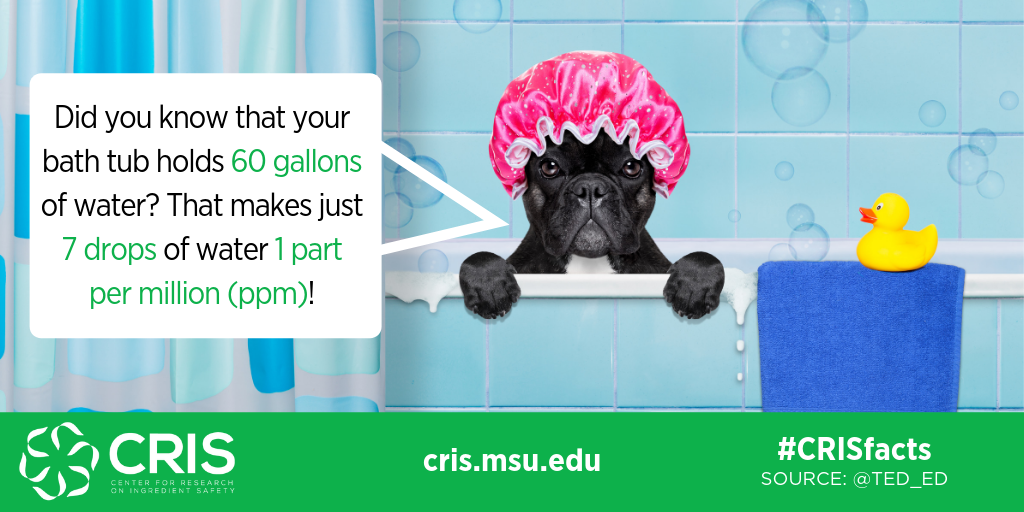
Ted Ed put together a fantastic video helping to explain parts per million.
Advances in testing technology mean scientists can now detect substances at levels that were impossible to measure decades ago. Detection tells us something is present, but risk assessment tells us whether that amount matters for health.
For example:
1 ppm = 0.000001 of 1
1 ppb = 0.000000001 of 1
1 ppt = 0.000000000001 of 1
Does all water contain the maximum allowed amount of a trace contaminant?
No. A regulatory limit represents the highest amount permitted under safety standards, not the amount typically found in drinking water.
Actual levels vary depending on factors like:
- Local geology
- Water sources
- Infrastructure
- Agriculture
- Industrial activity
- Environmental conditions
For example, one region may naturally have higher levels of certain minerals, while another may have different trace substances based on its local environment. We can review local drinking water reports to better understand our community’s water quality.
The good news.
Finding a trace contaminant in water does not automatically mean the water is unsafe. Thanks to advances in analytical technology, scientists can measure substances at incredibly tiny levels. However, the presence of a substance alone does not determine risk. The amount, frequency of exposure, and toxicological profile all matter.
That’s why scientists and regulators evaluate contaminants using the principles of risk assessment. Drinking water standards are designed to keep exposures well below levels expected to cause harm and are continuously reviewed as new scientific information becomes available.
If you have any questions about ingredients or ideas for a blog post, please send us an email or submit your idea to us at go.msu.edu/cris-idea.
Citations and further reading.
U.S. Environmental Protection Agency. (2021, November 16). Per- and polyfluoroalkyl substances (PFAS). https://www.epa.gov/sdwa/and-polyfluoroalkyl-substances-pfas
U.S. Environmental Protection Agency. (2026, May 18). Proposed PFAS rescission rule. https://www.epa.gov/sdwa/proposed-pfas-rescission-rule
U.S. Environmental Protection Agency. (2026, May 18). Proposed PFOA and PFOS compliance extension rule. https://www.epa.gov/sdwa/proposed-pfoa-and-pfos-compliance-extension-rule
U.S. Environmental Protection Agency. (2026, April 2). EPA takes bold action to ensure drinking water is safe from microplastics, pharmaceuticals, and potential hidden contaminants. https://www.epa.gov/newsreleases/epa-takes-bold-action-ensure-drinking-water-safe-microplastics-pharmaceuticals-and
U.S. Environmental Protection Agency. (2026, April 2). EPA, HHS announce historic actions to protect Americans from microplastics and safeguard drinking water. https://www.epa.gov/newsreleases/epa-hhs-announce-historic-actions-protect-americans-microplastics-and-safeguard
U.S. Environmental Protection Agency. (2024, October 30). Lead and copper rule improvements. https://www.epa.gov/ground-water-and-drinking-water/lead-and-copper-rule-improvements
U.S. Environmental Protection Agency. (2026, January 2). Lead and copper rule. https://www.epa.gov/dwreginfo/lead-and-copper-rule